
Shopping Cart


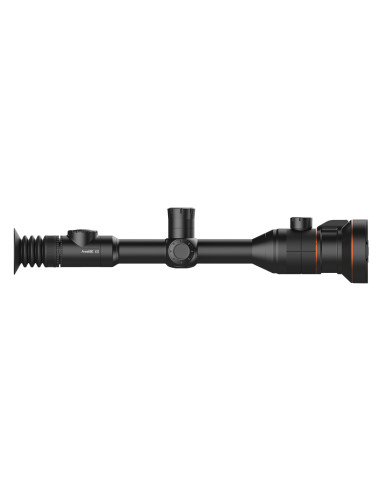

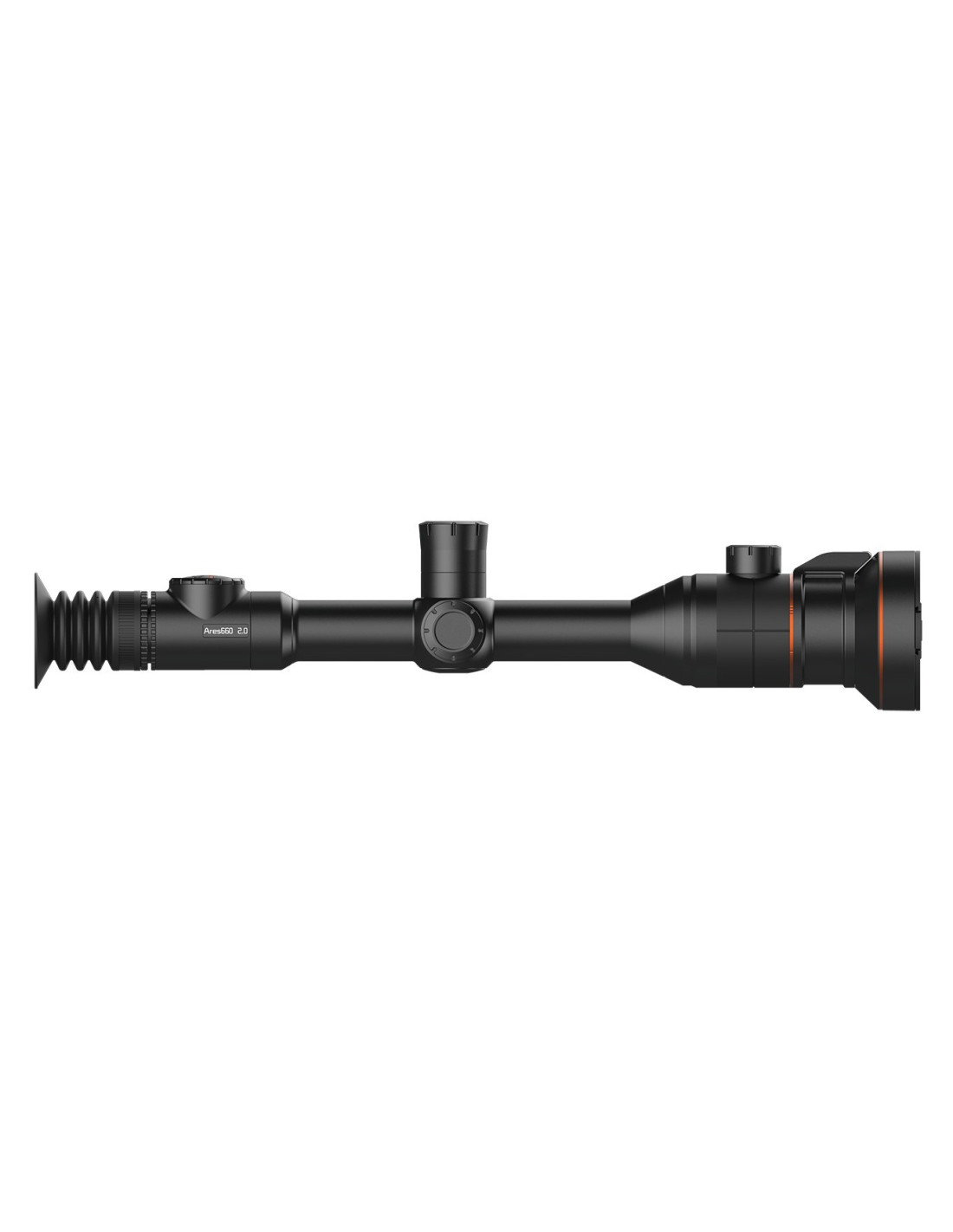
THERMTEC THERMAL RIFLESCOPE ARES 660 2.0
Estimated delivery 5 to 15 business days.
€2,472.00
€3,296.00
-€824.00
Tax included
Time left
ThermTec ARES 660 2.0 thermal riflescope with 640×512 sensor (NETD ≤ 20 mK) and dual field of view 20/60 mm F1.0 lens (1.1x / 3.2x), with detection up to 3000 m. 1024×768 AMOLED display, 64 GB, RAV recording, up to 16 h battery life, IP67 and 1072 g.
The ThermTec ARES 660 2.0 thermal riflescope is a tube-style thermal scope with a 640×512 pixel sensor (12 µm, NETD ≤ 20 mK, 50 Hz) and a dual field of view 20/60 mm F1.0 objective lens that switches between 1.1x and 3.2x with a lever. It has no laser rangefinder: it estimates the distance to the target with artificial intelligence (AI ranging). It belongs to the ARES 2.0 series, which ThermTec describes as 10% lighter than the previous generation, with a 1024×768 AMOLED display, 64 GB of internal memory and two batteries, one built-in and one replaceable 18650.
Features
- 640×512 sensor, NETD ≤ 20 mK: high resolution to see detail at long range, with AI image calibration that learns with use and keeps the image stable when conditions change; manual or automatic correction.
- Dual field of view 20/60 mm: the 20 mm lens (1.1x, 21.7° × 17.4°) is for scanning and the 60 mm lens (3.2x, 7.3° × 5.9°) for identification. A raised lever switches between them with one hand. Smooth 1x to 4x digital zoom (up to 12.8x) and detection up to 1000 m at 20 mm and 3000 m at 60 mm, according to the manufacturer.
- AI distance estimation and target detection: without a laser rangefinder, the scope estimates the distance to the target with AI (AI ranging) and, when connected to the ThermTec Outdoor app, sends a notification to the phone when it detects a target.
- 0.39-inch 1024×768 AMOLED display: 6 colour palettes, 7 reticles in 5 colours (black, white, red, green and blue), picture-in-picture (PIP) at 2x, 50 mm eye relief and ±5 dioptre adjustment.
- Zeroing: automatic or manual, with image freeze and zoom during zeroing and 5 profiles that store the distance, ammunition and reticle coordinates for each rifle.
- Recording and app: photo and video with sound on 64 GB of internal memory, recoil activated video (RAV) before, during and after the shot, and a Wi-Fi hotspot for the ThermTec Outdoor app (live view, file transfer and firmware updates).
- Up to 16 hours of battery life: one built-in 18650 battery plus one replaceable 18650 or 18500; 3-second start-up and programmable auto power-off.
- Built for the field: IP67, operating range −20 °C to +50 °C, recoil resistance up to 6000 J, standard 30 mm ring mounting and a silent lens cover that rests against the body when open.
Why choose this model?
The ARES 660 2.0 is the dual field of view scope with a 640×512 sensor: the 20 mm lens gives a wide field for scanning and the 60 mm lens takes detection to 3000 m for identification, without changing scopes. It suits hunting in open country, where an animal may appear close or very far away.
It weighs 1072 g and has no laser rangefinder; the ARES 660 2.0 LRF adds a 1000 m rangefinder and ballistic calculator.
Technical specifications
| Field | Value |
|---|---|
| Brand | ThermTec |
| Model | ARES 660 2.0 (manufacturer name: Ares660 2.0) |
| Type | Thermal tube riflescope |
| Sensor | 640×512 pixels, 12 µm, uncooled |
| NETD | ≤ 20 mK |
| Spectral range | 8–14 µm |
| Frame rate | 50 Hz |
| Objective lens | 20/60 mm, F1.0 (dual field of view) |
| Field of view | 21.7° × 17.4° / 7.3° × 5.9° |
| Field at 100 m | 38.4 × 30.7 / 12.8 × 10.2 m |
| Optical magnification | 1.1x / 3.2x |
| Digital zoom | 1x to 4x, smooth |
| Detection range | 1000 m (20 mm) / 3000 m (60 mm) |
| Distance measurement | AI estimation (no laser rangefinder) |
| Display | AMOLED 0.39 inch, 1024×768 |
| Eyepiece | 50 mm eye relief; 6 mm exit pupil; ±5 dioptres |
| Reticles | 7 types, 5 colours |
| Colour palettes | 6 |
| Zeroing profiles | 5 |
| Recording | photo and video with sound, recoil activated video (RAV), 64 GB internal memory |
| Connectivity | Wi-Fi (hotspot, ThermTec Outdoor app), USB-C for data |
| Battery | 1 × built-in 18650 + 1 × replaceable 18650 or 18500 |
| Battery life | up to 16 hours |
| Max. recoil | 6000 J |
| Mounting | standard 30 mm rings |
| Protection | IP67 |
| Operating temperature | −20 °C to +50 °C |
| Weight | 1072 g |
| Dimensions | 435.7 × 89.5 × 92.9 mm |
Package contents
- ThermTec ARES 660 2.0 thermal riflescope
- 2 × 30 mm mounting rings
- 2 lithium batteries
- Charger
- USB cable
- Rubber eyeshade
- 18650 battery cap and 18500 battery cap
- Lens cleaning cloth
How to choose
All ARES 2.0 models share the display, memory, RAV recording, 30 mm mounting and IP67 build; the sensor, lens and rangefinder change. With 384×288: ARES 335 2.0 (35 mm) and ARES 360 2.0 (20/60 mm). With 640×512: ARES 650 2.0 (50 mm) and ARES 660 2.0 (20/60 mm). Each has an LRF version with a 1000 m rangefinder. The 640×512 sensor gives more detail; the 384×288 models run longer (18 h versus 16 h).
Frequently asked questions
What batteries does the ThermTec ARES 660 2.0 use?
It has one built-in 18650 battery and one replaceable 18650 or 18500 battery (caps for both sizes are in the box). Together they give up to 16 hours. The built-in battery charges in the scope and the replaceable one in the external charger supplied.
How far can the ARES 660 2.0 detect an animal?
The manufacturer states 1000 m with the 20 mm lens and 3000 m with the 60 mm lens. Detection means seeing that there is a heat source; recognising and identifying the animal requires much shorter distances.
Does the ARES 660 2.0 have a rangefinder?
It has no laser rangefinder: it estimates distance with AI (AI ranging). For laser measurement there is the ARES 660 2.0 LRF, with a 1000 m rangefinder and ballistic calculator.
Does the scope record shots?
Yes. Recoil activated video (RAV) records before, during and after the shot; it also takes photos and records video with sound on demand, on 64 GB of internal memory. The ThermTec Outdoor app shows the live image and transfers files.
How do you switch between 20 mm and 60 mm?
With the field of view lever next to the objective lens, operated with one hand. At 20 mm the field is wide (1.1x) for scanning; at 60 mm the magnification rises to 3.2x for identification.
Tap to zoom
